Character animation for kids, family & education brands
A character your audience knows,
in a new episode every month.
I build a character for your brand, then keep making episodes with it. Not one expensive film every two years.
Below is a series I made to prove I can do it. One dog, twenty episodes, fifty-eight minutes, one person.
The evidence
Proof before promises
I don’t have client case studies yet. What I have is a full series I produced end to end, specifically to prove the system holds up over time. Episode one and episode twenty-one were made months apart. Watch both — it’s the same dog, across 770-odd shots and twenty different worlds. That is what makes a monthly episode possible instead of a yearly one. Everything else on this page is downstream of it.


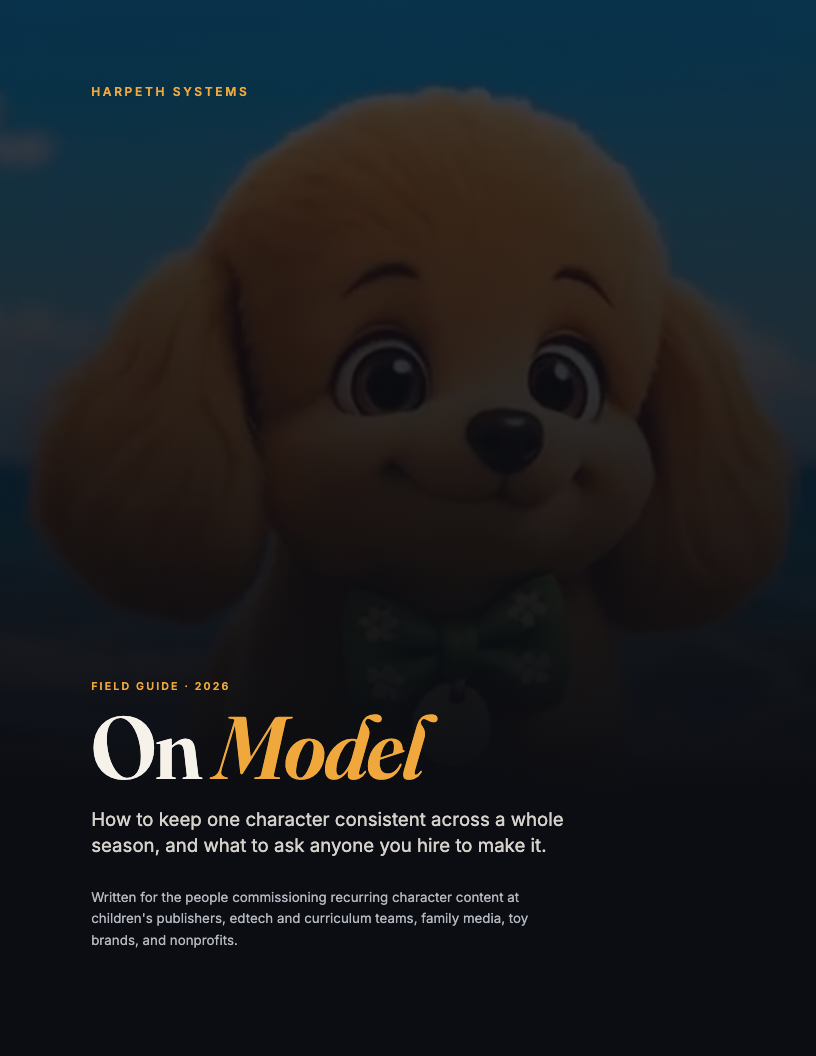 Free · 14 pages
The field guide
What to ask before you hire anyone
I made twenty-one episodes to work out what actually holds a character still across a season. This is what I’d want to know if I were the one commissioning it, including the twelve questions I’d ask me.
- Why a character drifts, and the five places it happens
- Four design choices that decide whether consistency is even possible
- What has to be in a style bible before you accept it
- Twelve questions to ask anyone who animates your character
How to work with me
One offer, two phases
Build the character first, then keep making episodes with it. The build stands on its own. If you never order an episode you still own the character outright, along with everything I used to make it.
Phase one
Character system build
I design your character and lock it down, so it can be produced over and over without drifting. Scope and timeline agreed before we start.
- Character design, turnarounds, and expression sheets
- Locked palette and a style bible your team can hand to anyone
- The consistency setup that keeps it identical shot to shot
- A first batch of finished content — typically a 60–90 second piece plus social cuts
- Design revisions before anything gets animated
You own the character, the designs, and everything I deliver.
Phase two
Episode production
Once the system is built, episodes get faster and cheaper, because the hard part is already done. Sold in batches of four to six, not as a monthly subscription.
- Script, animation, voice, and music for each episode
- An agreed batch, delivery window, and review schedule
- Landscape, vertical, and social cuts on delivery
- Same character, same rules, no re-litigating the design
I sell in batches rather than a monthly retainer on purpose. I would rather commit to work I can deliver than to a calendar I cannot control.
Inside a build
How a build runs
One person owns the whole thing, so there is no hand-off friction and no drift between what you approved and what ships. It also means you always know who to email.
- 01
Brief
Who the audience is, what the character has to do, and where the content will run. A short written brief we both sign off on.
- 02
Design & lock
I design the character and world, we revise on paper, and then the model sheet gets locked. Fixing a character here costs hours; fixing it in finished shots costs weeks.
- 03
Animate & score
Animation, voice, and music, with review checkpoints along the way. Nothing ships that I have not watched all the way through.
- 04
Deliver
Final files in the formats you need: landscape, vertical, captions, thumbnails, plus the style bible and source references you own.
No mystery
How it's made, in plain terms
I built a production pipeline that uses generative AI for parts of the animation process. That is how one person ships fifty-two minutes of finished film with the same character throughout. I am telling you on the homepage rather than three meetings in, because you would find out anyway and you would be right to be annoyed.
The character is designed, not generated
Consistency does not come out of a prompt. Each hero character is trained as its own model and held against a written registry of rules, so it is the same character in shot 300 as in shot 3. That is the part that makes a batch of episodes cost what it does.
A person is in every loop
I write it, direct it, check every frame, and fix what is wrong. Automated checks narrow down where to look; they do not decide what ships. Nothing goes out that I have not watched all the way through.
Rendering runs on my own hardware
Every model that renders a frame or a second of audio runs on a machine I own. No rendering work is sent to an outside service, so your unreleased footage is not sitting in a vendor’s logs, and no vendor can deprecate a model out from under you mid-season. Some upstream steps have used hosted tools; the inventory says which.
Licensing is tracked, not assumed
I publish an inventory of every model in the pipeline — what it does and what it is licensed under. When I found the base model I had started on was licensed for non-commercial use only, I migrated the pipeline and re-rendered the whole back catalogue rather than ship on it. The inventory is public, and it says how each license is known.
The full record — which models, which licenses, where the work is processed, and what I do and do not warrant — is written up at model provenance & licensing. It is written for your legal reviewer, not your marketing team.
If AI anywhere in your content pipeline is a non-starter for your brand or your audience, that is a legitimate call — and I would rather know in the first email than in the third meeting.
Fit
Who this is for
The common thread: you need a character your audience recognizes, and you need new content with it regularly — not one expensive film every two years.
Children's publishers
A character that lives on the page and needs to move — for social, for a book launch, for a school visit.
Curriculum & edtech
A recurring host who shows up in every lesson, not a one-off video that dates in a year.
Church & family media
Producing on a real schedule with a small team and a budget that has to stretch across a season.
Toy & consumer brands
A mascot that deserves more than a logo and a static render on the packaging.
Health systems & nonprofits
Explaining hard things to kids, where tone and consistency matter more than spectacle.
Not sure you fit? Send the character and the problem anyway. A straight no from me costs you one email.
Before you ask
Straight answers
The questions that actually decide whether this is worth a call, answered without the sales voice.
- Do you have clients?
- Not yet. You would be the first, and I would price and treat it accordingly. Everything on this page is work I produced on my own to prove the system — it is not client work dressed up as a case study.
- Who owns what?
- You own the character, the designs, the style bible, and every finished file. I keep my production pipeline. I do ask for the right to show the finished work in my portfolio — that is negotiable, but I will tell you up front that it matters to me.
- Is it cleared for commercial use?
- Every model in the pipeline is inventoried on my provenance page — what it does and what it is licensed under, including the rows I have not finished verifying. Most are Apache-2.0 or MIT. The video model is under a community license that is free for commercial use below a revenue threshold, which sits with me as the licensee and does not attach to you. I started on a base licensed for non-commercial use only and re-rendered the whole back catalogue to get off it. What those licenses are not: a warranty about training data, an indemnity, or a copyrightability opinion. I will not pretend otherwise.
- What if I need a change after it is animated?
- About two minutes to re-animate a shot and stitch it back into the episode, and under fifteen to rebuild and republish the finished episode around it — without touching the other thirty-odd shots. That is why revisions here are a conversation rather than a change order: asking for a different expression in shot 19 costs shot 19, not the episode.
- What happens when the technology changes?
- Each episode is stored as a written specification — shot list, timing, character bindings — and the finished video is generated from it. When a better model ships, the same specification re-renders against it. What you are buying is the character and the specs; the video files are the part that can be rebuilt.
- What if the first pass is wrong?
- Every build includes design revisions before we animate anything, because fixing a character on paper costs hours and fixing it in finished shots costs weeks. The model sheet gets locked only once you are happy with it.
- You are one person. What if you get hit by a bus?
- Fair question, and the reason the style bible is a deliverable rather than a nice-to-have. You would own the designs, the rules, and the reference material — enough for another animator to pick it up. You are not locked to me by anything except whether the work is good.
The studio
One person, a real pipeline
I’m Will. I’m an engineer by background — I spent my career building systems, not storyboards. Harpeth Systems started when I got interested in a specific problem: keeping an animated character genuinely identical across hundreds of shots, at a cost that lets a brand publish monthly instead of annually.
So I built the pipeline, and then I made twenty-one episodes of a kids’ series with it to find out whether it actually held up. It did. That series is still going. It’s mine, it’s how I keep improving the system, and it’s the work you’re watching above.
Based in Nashville, Tennessee, named for the Harpeth River. Working with brands anywhere.
Get in touch
Tell me about your character.
If you already have one, send me a picture of it and what you wish you could do with it. If you don’t have one yet, tell me who your audience is.
Either way I’ll come back with a straight answer on scope, cost, and whether I’m the right fit — usually within a day.